Product Discovery Through Agentic Intelligence
Designed an AI-native product discovery system that transforms ambiguous product concepts into structured specifications, validates architectural integrity through agentic workflows, and scales product reasoning across complex system environments.
Situation
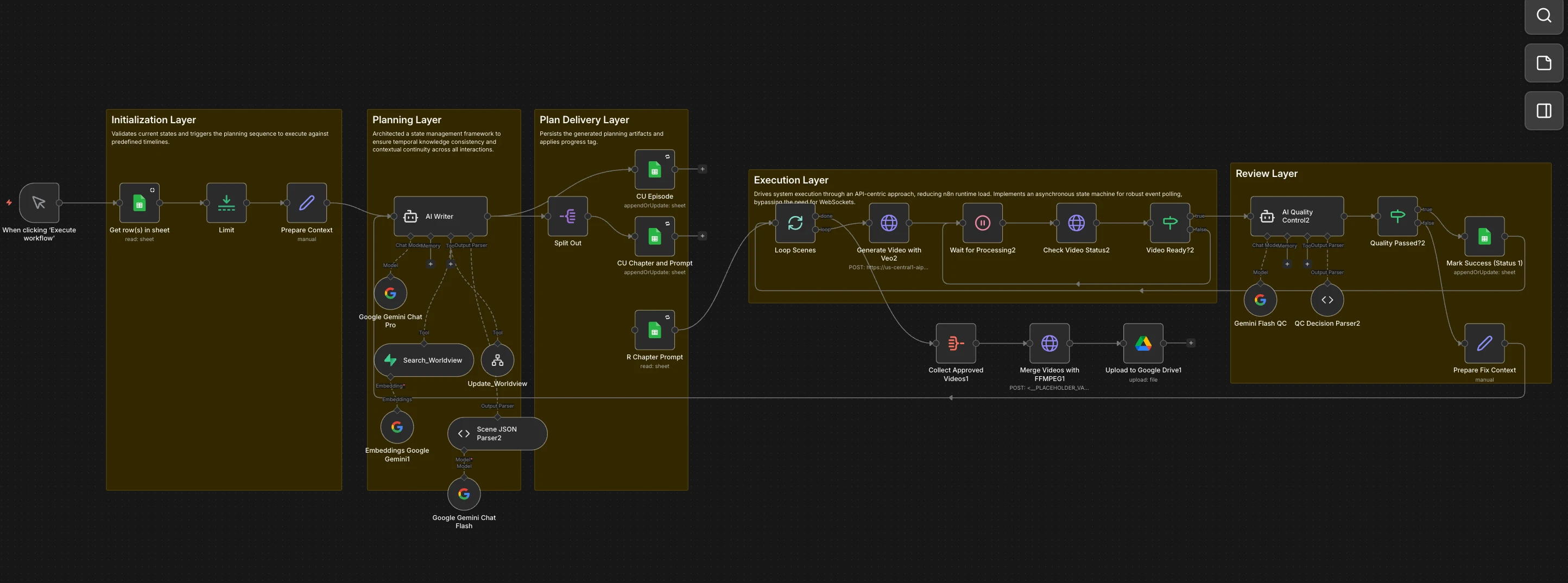
*Image for illustration only — a self-hosted n8n agentic workflow.
As product ecosystems scale, product reasoning becomes fragmented across PRDs, technical specifications, compliance constraints, and historical decisions. Early-stage discovery increasingly relied on manual synthesis, creating cognitive bottlenecks, inconsistent requirement quality, edge-case omissions, and slow validation cycles before engineering execution.
Task
Design a scalable AI-native product discovery system capable of transforming ambiguous product ideas into structured specifications while validating architectural consistency and reducing discovery-stage operational overhead.
Roles & Deliverables
Institutional Knowledge Architecture:
Built a centralized RAG-based knowledge layer integrating historical PRDs, technical specifications, compliance documentation, and architectural decisions into a unified product intelligence system.
Concept-to-Spec Orchestration:
Designed an agentic workflow capable of transforming high-level product concepts, fragmented requirements, and directional prompts into structured product specifications, dependency mappings, edge-case scenarios, and implementation-ready discovery artifacts.
Autonomous Product Validation:
Engineered a multi-agent validation workflow that cross-referenced newly generated requirements against historical logic, system dependencies, and compliance constraints to identify specification gaps, missing data flows, and architectural inconsistencies before engineering handoff.
Discovery Workflow Compression:
Integrated automated reasoning and scenario expansion directly into early product discovery workflows, significantly reducing manual cross-functional validation cycles without increasing operational overhead.
Result
AI-Native Product Discovery Model:
Established a new operating model where product discovery is no longer dependent on manual synthesis, but driven by structured AI-assisted reasoning and validation.
Product Intelligence Infrastructure:
Operationalized a reusable product knowledge and reasoning system that standardizes how requirements are interpreted, validated, and expanded across future product initiatives.
Impact
Discovery Cycle Compression:
- Accelerated product discovery and requirement validation cycles.
- Transformed weeks-long manual processes into near real-time iterative workflows.
Pre-Engineering Quality Assurance:
- Mitigated specification ambiguity and logic gaps before engineering handoff.
- Significantly decreased downstream rework and clarification loops.
Cross-Functional Efficiency:
- Reduced reliance on manual PRD reviews.
- Embedded automated validation and scenario expansion directly into early-stage product workflows.